
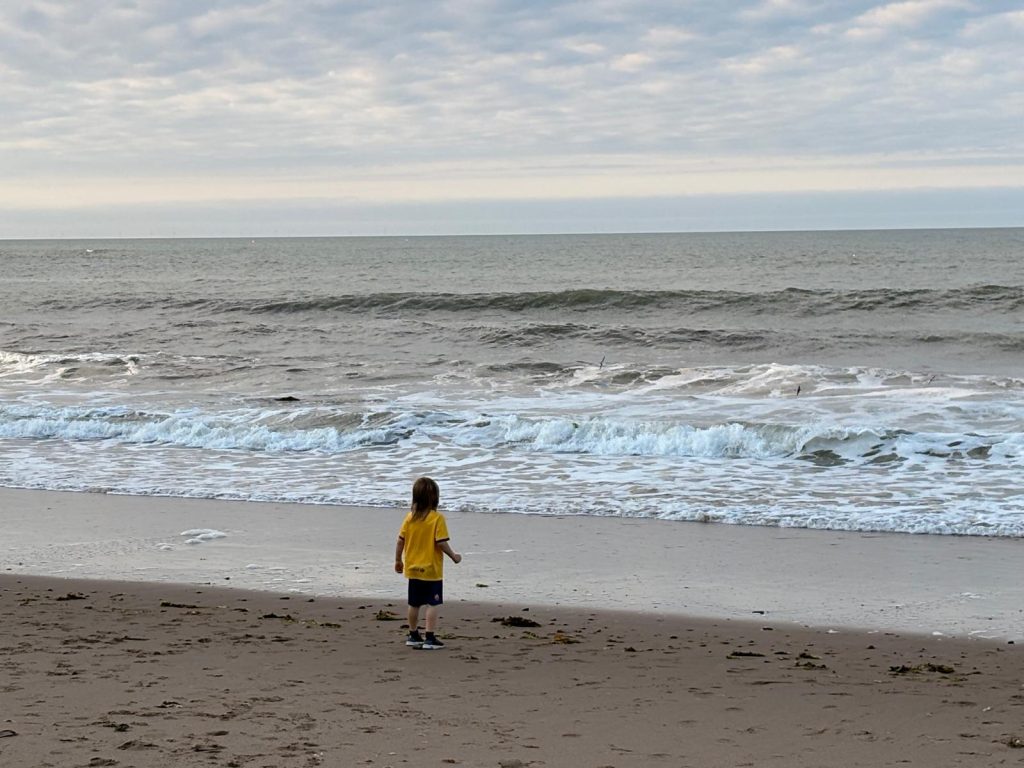
I didn’t book a retreat. Nobody took my phone off me at check-in. Or made me sign up to a wellness package with a hushed, Wi-Fi-free yurt. This was an ordinary family holiday to Scotland. The only thing that turned it into a digital detox holiday was a decision I made myself. Phone off, in the glovebox, for the whole week.
Deciding to do a digital detox holiday
It was one of my 40 Before 40 challenges, decided on about a month before we went. When I wrote the original list, it wasn’t this one that made me anxious just saying it. That was the tarantula I’ve still got to hold, despite a lifelong fear of spiders. Even so, I knew in the weeks leading up to the holiday that going a week without my phone could turn out to be one of the biggest challenges on that list for me. And I don’t say that lightly. Some people might look at “holiday without your phone” and think it sounds tame next to a tarantula. But the whole point of the list, as I said when I wrote about it, is that the challenges are personal, not pulled from Pinterest. And this one actually unsettled me in a way most of the others haven’t.
The morning we left for my digital detox holiday
We weren’t flying anywhere, so there was none of the airport-time pressure that turns UK holiday mornings into a countdown. One of the quiet benefits of holidaying in the UK. There was still packing to do, bags, and the car, just without a flight to hit. The frantic part was somewhere else entirely, knowing my phone was going…soon! I was messaging everyone who needed to know I wouldn’t have my phone for a week. Clients who might message and feel ignored. Friends who’d notice their WhatsApp ticks staying grey and start to worry. My husband and kids agreed to text my mum once we’d arrived, so she’d know we were there safely. Not everyone I’d messaged beforehand, just her.
Then, as my husband reversed us down the drive, I switched the phone off and dropped it into the glovebox. I’ll admit I’d been playing a game on it right up until that moment — not proud of it. But it’s part of why the whole thing felt like a challenge in the first place.
Getting there
Getting to Scotland without a sat nav turned out to be the easy bit. We were staying just off the A9, so it was road signs the whole way. When we hit traffic, I was completely relaxed about it — que sera sera, more or less. My husband and kids had their phones on them, since they hadn’t signed up to my challenge. But hubby was driving so I had to use his phone to check how long the hold up was. Before he decided if to detour. I wasn’t about to make an issue of it less than an hour from home. The challenge was mine, not theirs after all.
The phone did stay in the glovebox the whole week. But I’d brought it along in the first place for one practical reason… If I ended up needing to nip to a shop on my own, I wanted it there as a backup. Since anywhere useful was the best part of thirty minutes away. Ruining everyone else’s holiday over my own challenge, if something genuinely went wrong, felt like the wrong trade. As it happened, the thing I wasn’t sure about was whether my cards would even work. I’ve used Apple Pay for so long I couldn’t tell you the last time I paid with a physical card. My credit card didn’t work when I finally tried one; the debit card did. Luckily I found both on the morning of the trip!
A different journey for my digital detox holiday
I started a book on the journey north. Which was strange because for years I’d told myself I couldn’t read in the car. I used to read on car trips as a child. Then somewhere along the way convinced myself it made me feel sick. One bendy road, one too-warm afternoon, and mum saying reading in the car would make her sick. And that belief set like concrete for a couple of decades. When you actually think about it, how different is reading a book to looking at a phone screen while moving? If anything, my eyes probably cope with a book better than they’d cope with a phone as everything scrolls.
I knitted too, something I’ve found in the last couple of years. It works really well on a journey because you can still see the sights. I still have to look at my knitting but can look up a bit too. I stopped and read when my hands hurt and then knitted some more when they felt rested.
The pull of habit
What surprised me wasn’t the big stuff, it was how often I nearly reached for my phone out of habit. Then remembered I couldn’t, and just carried on. That pull faded within a couple of days. My nervous system noticeably calmed down. I hadn’t clocked how much low-level stress I’d been carrying from my phone until it wasn’t there to carry anymore.
That tracks with the research too. A study out of Loughborough and Lancaster universities found that even short periods away from your smartphone shift mood and anxiety levels, not just habits. It isn’t only a nice feeling I’ve talked myself into — there’s something measurable going on underneath it.
The habit-reaching showed up in smaller ways too. At one point I wanted a calculator, another time I wanted to Google something. Both not critical. Both things I could easily have borrowed my husband’s phone for. I didn’t bother either time, and I can’t remember what I wanted to search for. Which rather proves it wasn’t all that necessary in the first place, I think. My brain benefitted from being a calculator too! It just took longer but I had plenty of time, saved from phone use mostly!
Where I nearly caved
Day six — which in my head was very much day five, because holiday brain is a real and powerful thing — I took my statin and realised I had one tablet left. It needed a prescription request and you have to do it on the NHS app now, you can’t call them. But leaving it any longer meant running out entirely, and having to wait when I got back too. and I didn’t want that hanging over the last few days.
So I reluctantly went out to the car and dug the phone out from underneath everything else in the glovebox. It felt really weird, not welcome in the slightest. That surprised me, I can tell you, given it’s a device I’d normally have glued to my hand.
I typed my passcode in wrong, having forgotten what it was in such a short time. Then I walked to the beach to find enough signal to load the NHS app. Because the Wi-Fi where we were staying was intermittent, at best. It took longer to walk there and back than the entire time I actually had the phone switched on. Notifications stacked up the second I got signal; I ignored every one of them. I sent the prescription request, and turned it straight back off. The irony wasn’t lost on me that the one time all week I broke my own rule wasn’t for anything I wanted. It was to sort my first repeat prescription for a drug I’d been putting off taking for half a year.
The “what if there’s an emergency” question
That’s the question everyone asks when you tell them you’re doing this. It was the first thing people said to me too, before I’d even left. So here’s my honest answer: do it while the people who need you most are actually with you. Then be honest with yourself about how much of your daily phone use is really about emergencies. For me, once I looked at it properly, the answer was almost none of it.
Most of what we brace ourselves for simply doesn’t happen. My dad’s older and has Parkinson’s, my mum lives alone, and my kids are sometimes with their dad rather than with me. I have real reasons to want to stay reachable, and I’m not pretending otherwise. But issues arising from those situations are rare, not routine. And staying permanently on standby for something that almost never happens doesn’t actually protect anyone. It just keeps your nervous system switched on for no good reason. If it’s a real emergency, the police knock on your door. They don’t wait for you to notice a notification.
I’d already made one change before this digital detox holiday — moving my phone charger out of my bedroom so I physically can’t scroll in bed. This week pushed that further. I’ve come home realising how much of my phone use I was quietly excusing as “work” when it wasn’t really, and how little of that scrolling stayed with me afterwards compared with a book I can still tell you the plot of weeks later.
You don’t need to book a retreat to switch off. You just need a glovebox and a bit of nerve.
What I’m Taking Home From My Digital Detox Holiday
I feel properly rested in a way a normal week off probably wouldn’t have managed on its own. I’ve come back wanting to sort my notifications out. Also, delete a few apps I don’t need, and generally stop treating my phone’s version of urgency as my own. I noticed the kids seemed to use their devices less too. So I’m definitely thinking of doing similar again.
I did consider switching it back on for the drive home, on the technicality that the holiday was technically over. In the end I decided against it — the journey is part of the holiday to us, always has been. It’s something we say properly, not just something I told myself to avoid catching up on notifications in the car; my husband even put it in his wedding vows. Switching my phone on for that last stretch was never really on the cards once I thought about it properly.
Instead I read, knitted — not at the same time, I’m not that coordinated — and sang along to two entire Bon Jovi albums and whatever else came on, with my husband doing exactly the same, badly, next to me. The kids told us off more than once for our song choices and our singing. It was fabulous. We even stopped in at Holy Island on the way home. And for a pub lunch near where we married in Northumberland. The journey was indeed very much part of the holiday.



Do you fancy a digital detox holiday?
If you’ve ever wondered whether you could survive a week without your phone, attempting your own digital detox holiday. You probably could, and you might come back calmer than you left. If I can manage it, you definitely can! I say that as someone who was, before this trip, averaging five hours of screen time a day. Not something I’m remotely proud of. Doing it as I did, without a retreat also fits how my husband and I try to live generally. Fairly minimalist at heart, big believers that not everything worth having comes with a price tag.
If you want to see what the research actually says about how smartphone breaks affect mood and anxiety, this study from Loughborough and Lancaster universities is worth a read. And if you’re curious what else made my 40 Before 40 list, here’s the full story behind it.
Enjoyed this blog on my digital detox holiday?
Check out our other recent blogs here – Blog – Love Life More
Remember, loving life more isn’t about perfection or having all the answers. It’s about remaining open to growth and finding joy in the journey, wherever it leads you.
If you found this helpful, subscribe to our newsletter for more practical ways to love life more.