
I promised you the practical tips for slow travel South America. The how. The bit where I stop telling you about ducks in a row and actually tell you what we did when the money ran low, the sim card turned into a saga, and how we found our way through countries with no plan.
So here it is — not a checklist, because I don’t really believe in those, but the things that actually got us through fourteen months of slow travel across South America without falling apart. Consider it a starter kit, not a manual.
Cash Was King, and Argentina Taught Us That the Hard Way
Before we left I’d read all the practical tips for slow travel in South America I could find. Digital eSIMs, hidden money belts, never take your phone out — honestly, some of it read like we were about to be dropped into a warzone rather than go travelling. Our actual reality was much calmer than that, but money still needed a system, because “just wing it” is a lovely idea until you’re standing in a queue with no local currency and a bus leaving in ten minutes.
We ended up with three ways of getting money — Western Union, our Revolut card, and Remitly — and the rule was simple: check the rates and fees on each when we arrived somewhere, then use whichever came out best. Nothing clever. Most of the time it was all fairly equal anyway, so it came down to convenience — card in the shops and restaurants, cash for the market stalls and the little places off the beaten track that will never see a card machine in their life.
Then we got to Argentina (in 2025), and every single one of those calm assumptions went out the window.
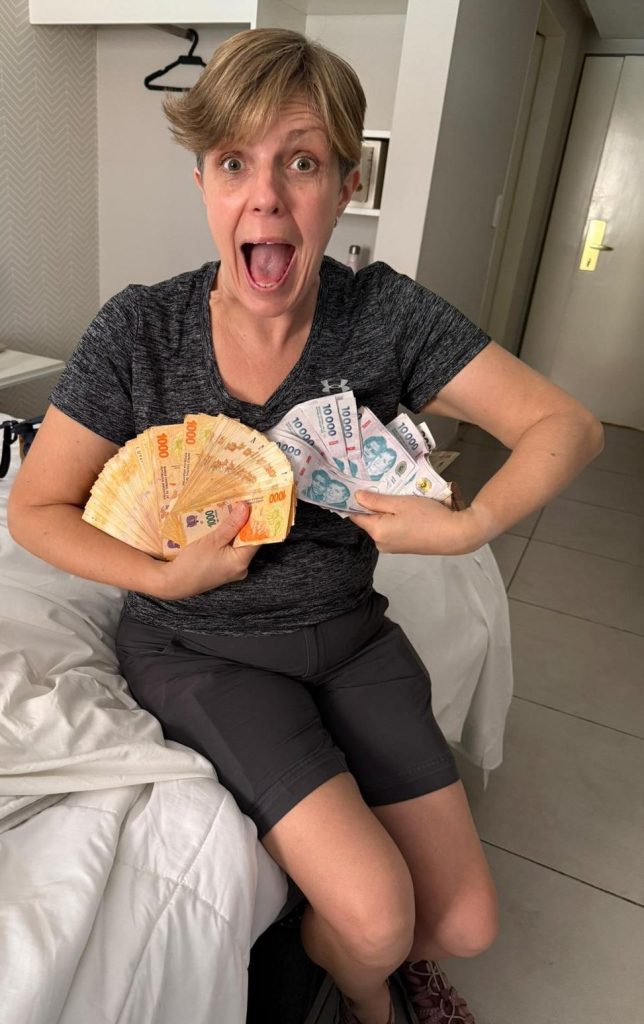
Cash was king there, properly king. Using a card was technically possible, but the exchange rate was awful and on top of that traders would add anywhere from 5 to 20% just for the privilege of letting you use it. So we got Argentinian pesos through Western Union instead — except you could only withdraw the equivalent of £300 at a time, and they gave it to you in such low denominations that £300 came out as an actual wad of cash! Notes worth about 30p each! It looked like something out of a film about hyperinflation, because that’s basically what it was.
Lesson learned: read the room, not just the guidebook. What worked everywhere else fell apart completely in one country, and the only way we knew that was by actually being there and paying attention.
One more thing on money — download the Travel Spend app before you go. The icon is a little red suitcase, the free version is perfectly sufficient, and it lets you both log spending as you go. It tracks daily spends, breaks them into categories, and shows you running averages without you having to think about it. We upgraded to the paid version at some point, but honestly it wasn’t necessary.
The Sim Card Saga — And the Simpler Solution We Found
Right. The sim card situation. I want to tell you about this because every single guide says get a local sim in each country, and for us that advice turned into an actual saga.
We got a local sim when we arrived in Peru. Should have been straightforward. Somehow — and to this day neither of us is entirely sure how — we ended up on what appeared to be a contract, and started getting final demand emails for something we were fairly certain we hadn’t signed up for. Ren is far more tech-minded than me, and even he decided that the path of least resistance was the better strategy.
So we scrapped the local sim approach entirely, and instead bought data packages through our Revolut card. A single bundle of either 5 or 10GB on Ren’s phone — depending on whether we knew we’d have regular WiFi access — I hotspotted off his when I needed to, and we both connected to WiFi wherever we could find it. The bundle comfortably lasted the 28 days it was valid for. Prices varied between countries — cheapest was about £7, average around £15, most expensive £22.
Could we have saved money by persevering with local sims? Possibly. Did we save our sanity by not doing it? Absolutely.
One thing I will say about connectivity: download WhatsApp if you don’t already have it, and use it constantly. WhatsApp is the communication tool across South America — everything runs through it. Small guesthouses, volunteer placements, local restaurants with no website, the host who needs to tell you the gate code — it all comes through WhatsApp. Nobody texts. Nothing is on email. If you’re not on WhatsApp, you’re essentially unreachable.
The Map Pins System — Our Actual Golden Egg of Practical Tips for Slow Travel South America
If you take one thing from this post, take this.
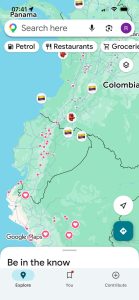
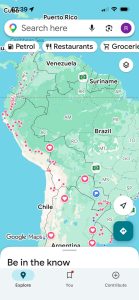
Somewhere in the first few weeks I started dropping pins on Google Maps every time anyone told us anything — a restaurant recommendation from a stranger on a bus, a “you MUST go to this town,” a hummingbird feeding spot for £2. Just a pin, in the moment, so I wouldn’t lose it.
Then I got a bit more organised, because that’s who I am even when I’m trying not to be. Each country got its own group and its own icon. I’d write a little note on every pin — “recommended by young French lad on the bus from Medellín,” that sort of thing — so months later I still knew why it was there and who to silently thank.
And here’s the bit that actually changed how we travelled: when it came time to plan a route through a country, I wouldn’t look at a list. I’d look at the map. Clusters of pins showed us the route before we’d consciously worked one out — it was just there, sitting on the screen, obvious. Same with choosing which part of a city to stay in. A cluster of good bars and restaurants on the map told me more than any “best places in Medellín” Google search ever could.
I do have one regret. When we didn’t end up using a recommendation, I’d delete the pin instead of just relabelling it “not used” and keeping it. I wish I hadn’t — it would have been fascinating to go back to.
Talk to People — It’s Not Really About the App
The pins were only ever as good as the conversations behind them, and most of our best information never came from Google at all. It came from people.
If I heard English on a bus, I was changing seats to go and talk to them. Cafés, bus terminals, free walking tours — same thing every time. Ren calls it having “more front than Blackpool beach.” I don’t disagree, and I have no shame about it, because it worked.
The best example of that: if it hadn’t been for a conversation with a fellow volunteer, we’d never have known about Choquequirao — a sister site to Machu Picchu, only reachable on a self-guided five-day hike, with under 50 visitors a day and a fraction of the cost of its famous neighbour. Nobody puts that in a guidebook. Somebody puts that in a conversation, over dinner, because they’ve done the twenty-five hours a week of volunteering that gives you the time to actually talk to people properly, not just pass them on a platform.
All of the details are in my FREE guide, coming very soon.
What This Practical Tips For Slow Travel South America Actually Means
None of this is a checklist you can tick off before you go. It’s more that the practical stuff and the emotional stuff turned out to be the same stuff. The pin system worked because I was curious enough to talk to strangers. The money system worked because we paid attention rather than following a rule blindly into a country where it stopped applying. Nothing about logistics on a trip like this is separate from how you actually choose to move through the world once you’re in it.
If you want the full practical detail — the complete money breakdown by country, the packing list, the visa reality, the bus booking tips, and everything else from fourteen months on the road — we’re putting that together as a dedicated travel guide. Watch this space.
I’m Ruth — contributor to Love Life More and voice behind the Slow Across South America series. You can follow along on my Facebook page here.
Remember, loving life more isn’t about perfection or having all the answers. It’s about remaining open to growth and finding joy in the journey, wherever it leads you.
Enjoyed this? Subscribe to our newsletter for more from Love Life More — and more from Ruth as the South America series unfolds.
What’s the one bit of “practical advice” you were given before a big trip that turned out to be completely wrong once you actually got there? I’d love to hear about it in the comments.
More from the Slow Across South America series
Check out our other recent blogs here — Blog – Love Life More